Table of Contents
For many years, organizations have had two options when they need new information systems. They could create a new system using their own developers, similar to getting a custom-made suit or dress that fits perfectly but comes with higher costs and a longer wait time. Alternatively, they could purchase a system from an external vendor, similar to buying off-the-rack clothing that doesn’t fit as well but is more affordable and can be installed faster. Sometimes, companies can customize these vendor systems to some extent, but often, it’s easier to adapt their business processes to fit the system rather than the other way around.
However, nowadays, a third option is gaining popularity: low code/no code (LCNC) applications. These applications can closely align with business requirements, are quick to implement, and generally cost much less than in-house developed systems. These benefits are not achieved through magic; rather, LC/NC applications empower users to take charge of development instead of relying on professional system developers.
Through user-friendly interfaces with point-and-click or pull-down menus, users can typically design and execute their own systems for their departments within a few hours. Some of these software tools may also feature conversational or search interfaces, and they usually do not require any significant programming skills.
Robotic process automation (RPA), as an illustration, represents one of the rapidly growing segments within the domain of LCNC systems. Employing predefined rules for basic decision-making enables users to create automated workflows that can interact with multiple information systems.
This is particularly advantageous for automating administrative tasks in the back office. Certain RPA tools even include advanced features that facilitate the identification of automation opportunities or connectors to AI tools, resulting in what is often referred to as “intelligent” or “augmented” automation. While RPA is generally categorized as low-code, there are “light” versions of the software that are considered no-code, resembling a “plug and play” approach, though, for customization and scalability, they offer fewer options.
Other instances of LCNC tools encompass low-code workflow or case management systems, a contemporary reinterpretation of conventional business process management tools, as well as virtual assistants or chatbot platforms, and operational-specific tools designed for marketing purposes.
These tools now provide user interfaces that transform the creation of new applications and digital capabilities into a point-and-click and menu configuration process, eliminating the need to hire and manage a large team of developers.
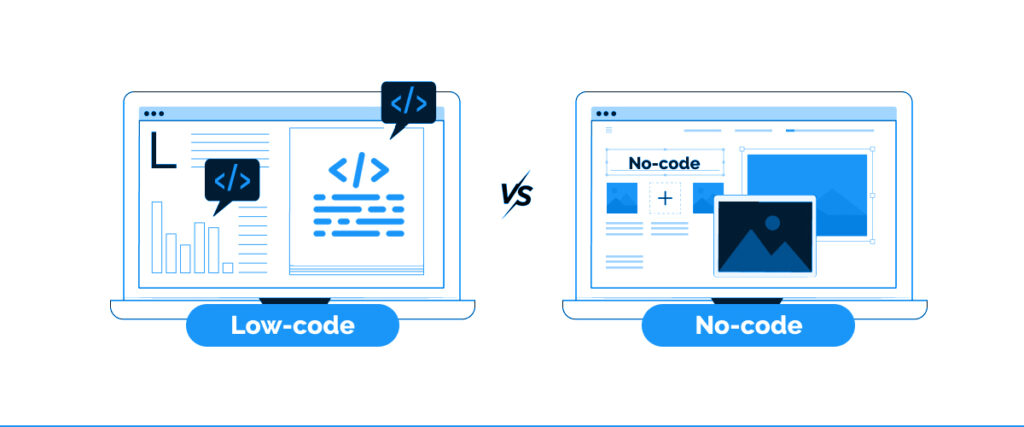
This significantly broadens the pool of individuals capable of creating software applications within a business. Low-code software, which, as the name implies, may still necessitate a certain degree of programming skills, is typically utilized by professional software developers or hybrid business/IT professionals to enhance their efficiency.
Related : Impact of Generative AI on Low-Code/No-Code Development
On the other hand, no-code software is designed for use by non-technical business individuals, often referred to as “citizen developers.” For many companies, this enables them to digitalize and automate tasks and processes more rapidly than attempting to recruit and onboard difficult-to-find development talent.
However, there is an important caveat: when low-code or no-code software interacts with mission-critical or enterprise-wide systems, it still requires some level of IT involvement. As businesses explore low-code/no-code solutions, they must recognize that these platforms, while providing cost savings, time and error reduction, and other enhancement opportunities, still demand a certain level of technical expertise for scalability, maintenance, integration, and governance.
Common Low-Code/No-Code Functionality
Low-code and no-code software development approaches offer support for various types of applications. Among these, small business transactional systems are quite common. These applications handle business transactions, such as human resource management tasks like performance appraisals, reservation management for restaurants or other services, creating order quotes, managing field services, and similar functions. While larger companies may rely on expensive software packages or custom-developed programs for these tasks, small businesses can easily create their own solutions.
Another frequently encountered application is small-scale automation capabilities. While the automation of extensive enterprise processes and workflows typically requires the expertise of professional developers, many organizations also have smaller workflows that can benefit from automation. Comparable to more advanced robotic process automation, low-code and no-code versions can access databases, emails, and transactional systems to execute tasks as if a human user were working on a computer.
This makes them suitable for handling minor tasks that individuals usually need to address, including interactions with office productivity software like spreadsheets, word processing, and electronic file folders. As an example, the advertising and marketing agency Dentsu educated several hundred employees in the use of a low-code/no-code robotic process automation tool. One operations analyst, for instance, utilized it to automate the process of sending email notifications for late timesheets.
With LCNC applications, technology product designers may simplify configuration and device setup. They could be skilled programmers, but they want to keep those abilities for the product. It is possible for non-technical people to design straightforward programs for user configuration and setup.
Low-Code/No-Code Challenges
The adoption of low-code and no-code (LCNC) software development offers substantial advantages, but it also presents management challenges. The widespread use of these tools institutionalizes the long-standing issue known as “shadow IT,” which has plagued IT departments for many years and could exacerbate the problem if not properly controlled. Citizen developers often create applications that are not well-functioning or scalable, and later attempt to hand them over to IT. Alternatively, if the individual who created the application leaves the company, there may be no one with the knowledge to maintain or modify the system they developed.
Nevertheless, effective LCNC oversight can address this problem and facilitate the seamless transition of applications from citizen developers to professional developers when appropriate. IT organizations must retain some level of control over system development, including the decision regarding which LCNC tools the organization will endorse and support. In many cases, an optimal approach could involve a hybrid model where the user initiates development (approximately 80% of the work), which is then refined by a professional developer.
Alternatively, the user might create the initial application using a graphical interface tool and subsequently engage a developer to code it in a more scalable language like Python. In either scenario, the developer can document the system’s existence, ensure its proper functioning, and integrate it with any necessary data or transactional systems. We have observed instances where a single system developer supports ten or more citizen developers in such arrangements.
The primary responsibility for overseeing LCNC development will largely rest with department managers, as most resulting systems operate at that level. Encouraging department managers to facilitate LCNC development is essential. They should receive training on how the technology functions, which organization-approved tools to use, and the desired relationship between citizen developers and the IT department. Additionally, they should educate their department members about the opportunities and responsibilities associated with LCNC development.
Furthermore, department leaders and executive champions may need to enhance their knowledge of best practices for scaling LCNC tools, especially in organizations with extensive geographic reach. New organizational models, such as a federated Center of Excellence (COE), may need to be established.
These COEs could be supported by internal digital portals or “storefronts” where citizen developers, system developers, and leaders can collaborate, learn, and receive prompt assistance when they encounter obstacles. As LCNC systems expand and generate their own datasets related to business processes, additional investments in supporting analytics and infrastructure may be necessary to ensure effective governance.
In today’s business landscape, most organizations face a shortage of system development talent. While LCNC development is not a one-size-fits-all solution, it can help address some of these resource shortages. It is likely that, with time, systems will become even more user-friendly for common processes and use cases. Therefore it stated that there will be no coding in the future.
Platforms like GenCodex represent a new wave of technology that combines simple development tools with the ability to manage and deploy software across different systems. With the GenCodex platform, teams can work faster, create mobile and web software applications, automate tasks smartly, and rely less on specialized technical skills, all while keeping everything organized and salable.
As these easy-to-use tools continue to improve, many routine tasks will be automated or put together through visual interfaces, leading us toward a future where traditional coding becomes less common. While coding won’t completely disappear, the way we approach it will change significantly. Instead of writing every bit of code, developers and business users will be able to piece together intelligent components, automate their workflows, and concentrate on solving bigger strategic issues.
In this changing environment, platforms like GenCodex ai powered low code platform for web app are not just alternatives they are becoming the backbone of modern organizations that prioritize agility and innovation.