Table of Contents
Build Real Apps & Web with GenCodex
Transform your ideas into scalable solutions with a powerful low-code platform
Get StartedIn today’s rapidly changing world, every business is looking for better software solutions. Companies want website and apps that are quick, safe, able to grow with their needs, and easy to use. They also want to cut costs and get their products to market quickly. At the same time, many organizations are becoming more careful about controlling their own technology and keeping their data secure. Explore how a traditional development or low-code platform like GenCodex can reduce development time.
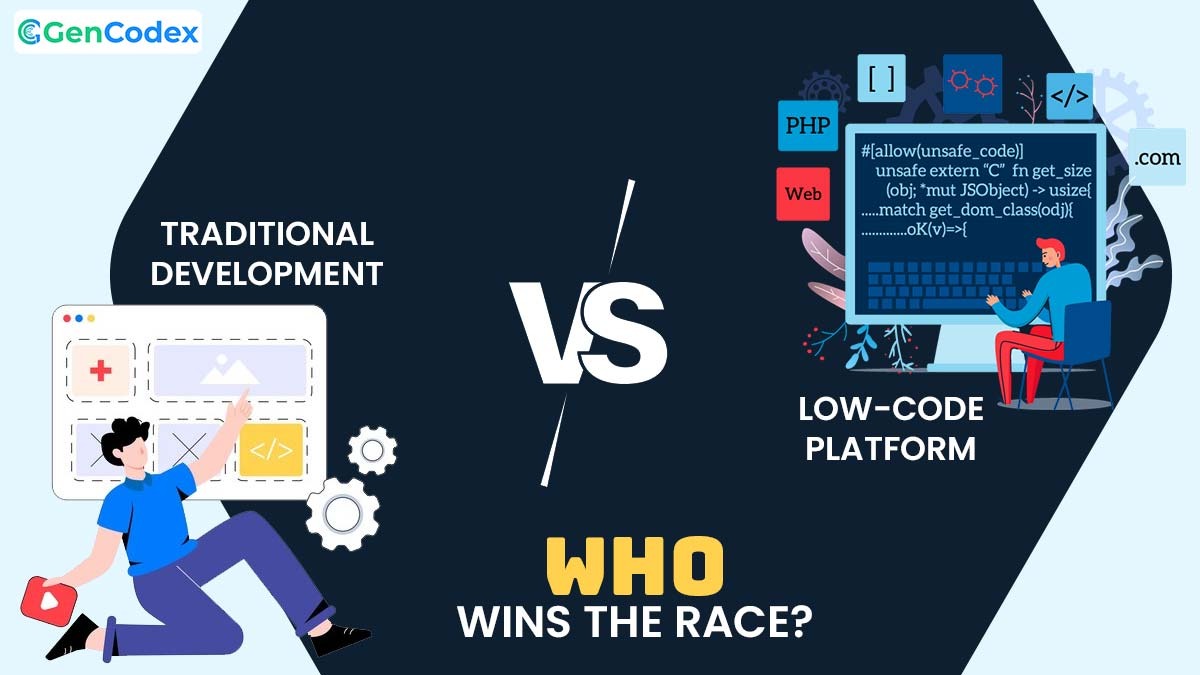
Which one should we choose go for low-code vs Traditional development programming?
This is an important choice. The right decision can save a lot of time, money, and effort, and it can also help a business expand more quickly. Let’s break down both options in simple terms.
Let’s break it down simply there are two main ways to create software today: low-code development and traditional development. Each method has its own style and benefits.
What is Low-Code Development?

Low-code development is a newer way to build apps that makes use of visual tools instead of writing lots of code by hand. It allows you to use simple drag-and-drop features and ready-made modules, which speeds up the development process and makes it easier for more people to get involved.
This approach opens doors for “citizen developers” people who understand the business side well but may not have much coding experience. At the same time, it still helps professional developers by giving them a platform to add custom code when more complex solutions are needed.
Low-code development is like a middle ground between two extremes:
- No-code development**, which requires no technical skills at all but offers very little room for customization.
- Traditional development, which needs specialized coding skills and allows for maximum flexibility and customization.
What is Traditional Development?

Traditional development sometimes called pro-code or full-code is the process of creating software by writing code using programming languages like Java, C#, or Python.
In this method, skilled developers start from scratch to design and build applications. They manage all aspects of the software, including how it’s structured, how it works, how it connects with other systems, and how it stays secure and performs well.
While traditional development offers the greatest flexibility and customization great for very specific and complex projects it also takes more time, requires advanced technical skills, and is generally more expensive than low-code builder solutions.
Traditional Development vs Low-Code Platforms: What Should You Choose?
There are two main ways to build modern software: traditional development and low-code builder. Traditional software development involves developers writing code manually using languages like Python or Java. This method provides complete control and is ideal for complex projects that need strong security and custom features.
Here’s a simple comparison that’s easy to read, based on the information given:
| Criteria | Low-Code Development | Traditional Development |
|---|---|---|
| Features | Uses drag-and-drop tools, ready templates, automation, and AI features to build apps quickly. Best for simple to medium projects. | Developers build every feature manually with custom code. Best for advanced and complex applications. |
| Speed of Development | Very fast. Apps can be built in days or weeks. | Slower. Projects may take months or longer depending on complexity. |
| Customization | Offers ready-made components with some custom coding options. Good flexibility. | Full customization. Every feature can be designed exactly as needed. |
| Cost and Resources | Lower cost. Needs fewer developers and less time. | Higher cost. Requires expert teams, longer time, and larger budgets. |
| Scalability | Can grow with business needs and handle more users over time. | Strong scalability for large enterprise systems and custom workloads. |
| Performance | Good performance for most business apps and daily operations. | Excellent performance for heavy systems and complex processes. |
| Maintenance | Easier maintenance with automatic updates from platform providers. | Needs dedicated teams for updates, bug fixes, and maintenance. |
| Security | Built-in security tools and standard compliance features. | Full control over security setup and custom protection systems. |
| Learning Curve | Easy to learn. Good for beginners, business users, and junior developers. | Harder to learn. Needs deep coding knowledge and experience. |
| User Experience | Ready UI components help create clean and modern apps quickly. | Full control over UI/UX design for unique customer experiences. |
Traditional vs Low-Code Development: Pros, Cons & Which Wins
Every business today needs software to grow faster and work smarter. But the big question is: how should you build it? The two most common approaches are traditional development and low-code. Both have their own strengths, so choosing the right one depends on your needs.
It’s simple to see the benefits of low-code development compared to traditional coding. When you look at them side by side, the differences become clear.
| Main Difference | Traditional Development | Low-Code Development |
|---|---|---|
| Coding experience | You write lines of code in a programming language, requiring knowledge of syntax and structure. Switching to a new language can feel like starting over. | A drag-and-drop interface makes development easier for both developers and non-developers. It simplifies workflows using visual models like flowcharts. Development speed is significantly higher—often 4–10 times faster. |
| Time to start a project | Setting up a project requires configuring a web server, database server, code repository, and required packages before development can begin. | You can get started quickly with just a few clicks, without complex setup or configuration. |
| Deployment | Deploying to testing or production requires manual environment setup, dependency management, and careful deployment planning. | Environments are pre-configured. Deployment is simplified—select the application, and the platform automatically manages dependencies and impacted components. |
| Reusability | Each project typically starts from scratch, requiring rebuilding of components and logic. | Low-code platforms enable reuse of modules, components, and services. Once created, functionality can be easily reused across multiple applications. |
Low-Code vs Traditional Coding: Which Delivers Better Results?
Building software has never been easier, but it raises an important question: who should create it and how? no-code for speed and ease, and traditional software development for depth and complexity. Each has its place depending on what you need! This is where two approaches come into play: no-code and traditional development.
No-Code Development: Creating Without Coding
No-code development is all about making things quick and easy. You don’t need to know anything about programming to use it.
- User-Friendly: Anyone can make apps without any coding knowledge.
- Simple Process: Just drag and drop elements to put your app together quickly.
- Speedy Creation: You can have an app ready in just a few hours or days.
- Cost-Effective: It takes less time and resources, making it more affordable.
No-code is perfect for business teams because it allows them to create simple tools quickly, without waiting on IT departments. However, it’s important to note that this method has its limits—it’s best for straightforward apps like surveys, dashboards, or small tools.
Traditional Development: Customized Solutions for Complex Needs
On the other hand, traditional development involves coding from the ground up, which is suited for more complicated projects.
- Fully Customizable: You can build exactly what you want, tailored to your specific needs.
- Advanced Features: This approach works well for complex systems that require special functions.
- Greater Control: You can manage important aspects like performance, security, and growth.
However, traditional software development usually takes more time, requires technical skills, and can be more expensive.
Predictions Trends for Low-Code Platforms in the Software Industry
While I’m not a future expert, I believe the future is bright for low-code platforms, especially as they incorporate artificial intelligence (AI) to simplify software development.
I work with the GenCodex low-code platform at Accelerated Focus, where we partner with businesses to help them maximize their low-code investment. Our passionate team focuses on personalized strategies that boost adoption and deliver innovative solutions globally. We’re not just creating apps; we’re building thriving businesses.
Since the mid-2010s, low-code adoption has skyrocketed. When I first explored GenCodex, it was a smaller player in a developing market. Today, it has a robust global network that is transforming software development. The GenCodex community is full of experts eager to assist newcomers and share ideas for new features.
What I love about low-code, especially GenCodex, is its adaptability. It evolves to meet the latest trends, whether in web and mobile apps or AI advancements, allowing it to tackle the challenges of the fast-paced tech landscape.
Related: Top Low Code Website Builders to Build Your Site Quickly
Does Low-Code Tech Replace Developers?
Let’s clear a common misunderstanding low-code does not replace developers. Many people think that if anyone can build apps using drag-and-drop tools, then professional developers are no longer needed. But this is not true.
Low-code makes development faster, but it does not remove the need for skills and experience. Non-developers can build simple apps, but they may not understand important things like system design, performance, or security. For example, they might create slow workflows or make mistakes that affect data safety. Building an app is easy, but building a good and secure app still requires expert knowledge.
This is where developers play an important role. They understand how to design strong systems, improve performance, and ensure proper security. They also help in adding advanced features and customizing applications when needed. Without developers, businesses may end up creating poor-quality apps quickly.
Low-code also does not remove job roles. Teams still need developers, testers, business analysts, and project managers. The real benefit is that the same team can now build more in less time.
In the end, low-code is not a replacement. It is a powerful tool that helps developers work faster and smarter.
Platforms like GenCodex easy website builder enhance the development process by offering both speed and flexibility. Ultimately, low-code solutions are not meant to replace traditional coding; rather, they are helpful tools that enable developers to work more efficiently and complete projects faster.
Conclusion
In today’s world of software development, both low-code and traditional methods have their advantages.
- Choose low-code if you want to get your projects done quickly and easily. It’s a great option for those who need to launch products fast.
- On the other hand, pick traditional development if you need more control over how your software works and want to customize it in great detail.
For most businesses looking to innovate and adapt quickly, low-code platforms like GenCodex Drag-Drop Website Builder provide a great mix of speed and flexibility.
Frequently Asked Questions (FAQs)
Q.1 – What’s the difference between low-code and traditional development?
Low-code development uses easy-to-understand tools and requires less programming, while traditional development involves a lot of manual coding and can be more complex.
Q.2 – Is low-code better than traditional development?
It really depends on what you need. Low-code is great for getting things done quickly and at a lower cost, while traditional development is better suited for more complicated projects.
Q.3 – Can low-code take the place of developers?
No, low-code doesn’t replace developers. It makes their work easier and faster but they are still needed for more specialized and detailed tasks.
Q.4 – Can low-code platforms grow with a business?
Yes, modern low-code platforms like GenCodex can handle growth and are built to support larger, more demanding business needs.
Q.5 – Is low-code a good option for startups?
Absolutely! Low-code helps startups quickly create and launch their products, even when they have limited resources.