Table of Contents
Build Real Apps & Web with GenCodex
Transform your ideas into scalable solutions with a powerful low-code platform
Get StartedArtificial intelligence is reshaping industries at an unprecedented pace. From enterprise software budgets and cybersecurity to healthcare, marketing, finance, and manufacturing, AI is becoming a core driver of business growth rather than an emerging technology.
However, finding reliable AI statistics is increasingly difficult. Many websites publish outdated figures, repeat unsupported claims, or mix projections with verified data.
To solve this, the GenCodex AI-powered low-code platform research team reviewed reports from leading organizations including Gartner, Stanford HAI, IDC, OpenAI, Google, Statcounter, Reuters, Similarweb, and other authoritative sources. Every statistic included in this guide has been carefully checked against the latest available data for 2026.
Rather than presenting numbers without context, we also explain what each trend means for businesses, marketers, developers, investors, and technology leaders.
Whether you’re writing a report, preparing a presentation, planning an AI strategy, or simply staying informed, this guide brings together the most important AI statistics for 2026 in one place.
Key Takeaways
After reviewing the latest AI data, several trends clearly stand out:
- AI investment continues to outpace overall IT spending, reinforcing its role as core business infrastructure.
- Enterprise adoption has become mainstream, with AI now integrated into most large organizations.
- AI is reshaping workforce skills, increasing demand for AI literacy and specialized expertise rather than replacing all jobs.
- Infrastructure and energy requirements are growing rapidly, making efficiency and sustainability increasingly important.
- Competition among leading AI platforms is shifting from model performance alone toward ecosystem integration and real-world business applications.
These trends suggest that AI’s next phase will be defined less by experimentation and more by measurable business outcomes.
Let’s look at the numbers.
Global AI Market Statistics
Key global AI market indicators and economic impact projections for 2026.
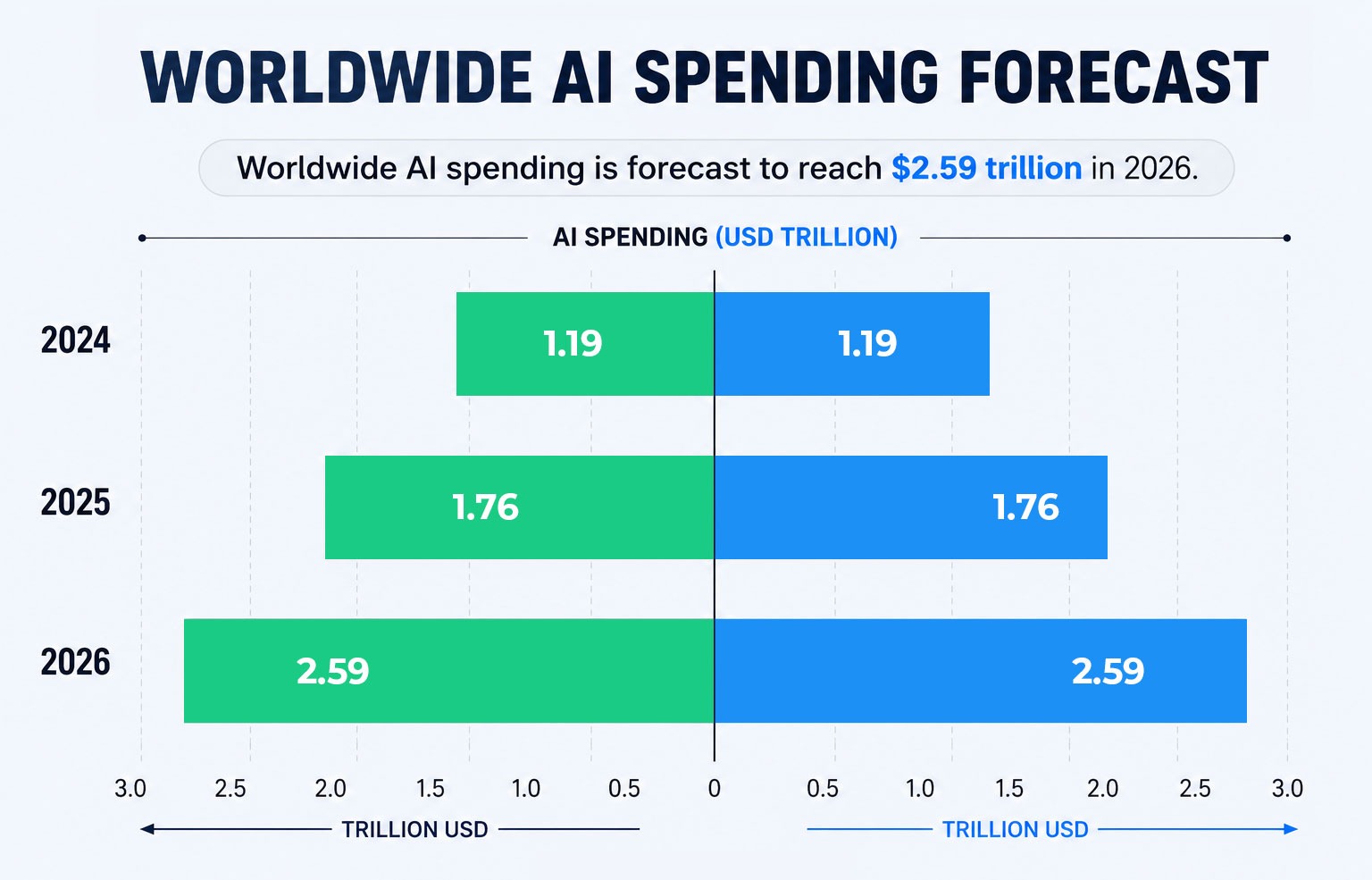
- Worldwide AI spending is forecast to reach $2.59 trillion in 2026. (Gartner)
- Global AI spending represents a 47% year-over-year increase from 2025. (Gartner)
- The total value global AI Software market is at $453.2 billion in 2026. The specific Generative AI market (all segments) is valued between $55.5 billion and $83.3 billion for 2026. (Gencodex)
- Total Information and Communications Technology (ICT) spending will reach $4 trillion globally in 2026. (IDC)
- The baseline macroeconomic report specifies that 7% ($7 trillion) global GDP boost will be realised over a 10-year period of adoption. (Gencodex)
Global Artificial Intelligence Market Growth (2025–2033)
Artificial Intelligence (AI) is changing how we live and work in many exciting ways. From automating repetitive tasks and enhancing creativity to improving business efficiency and reshaping entire industries.
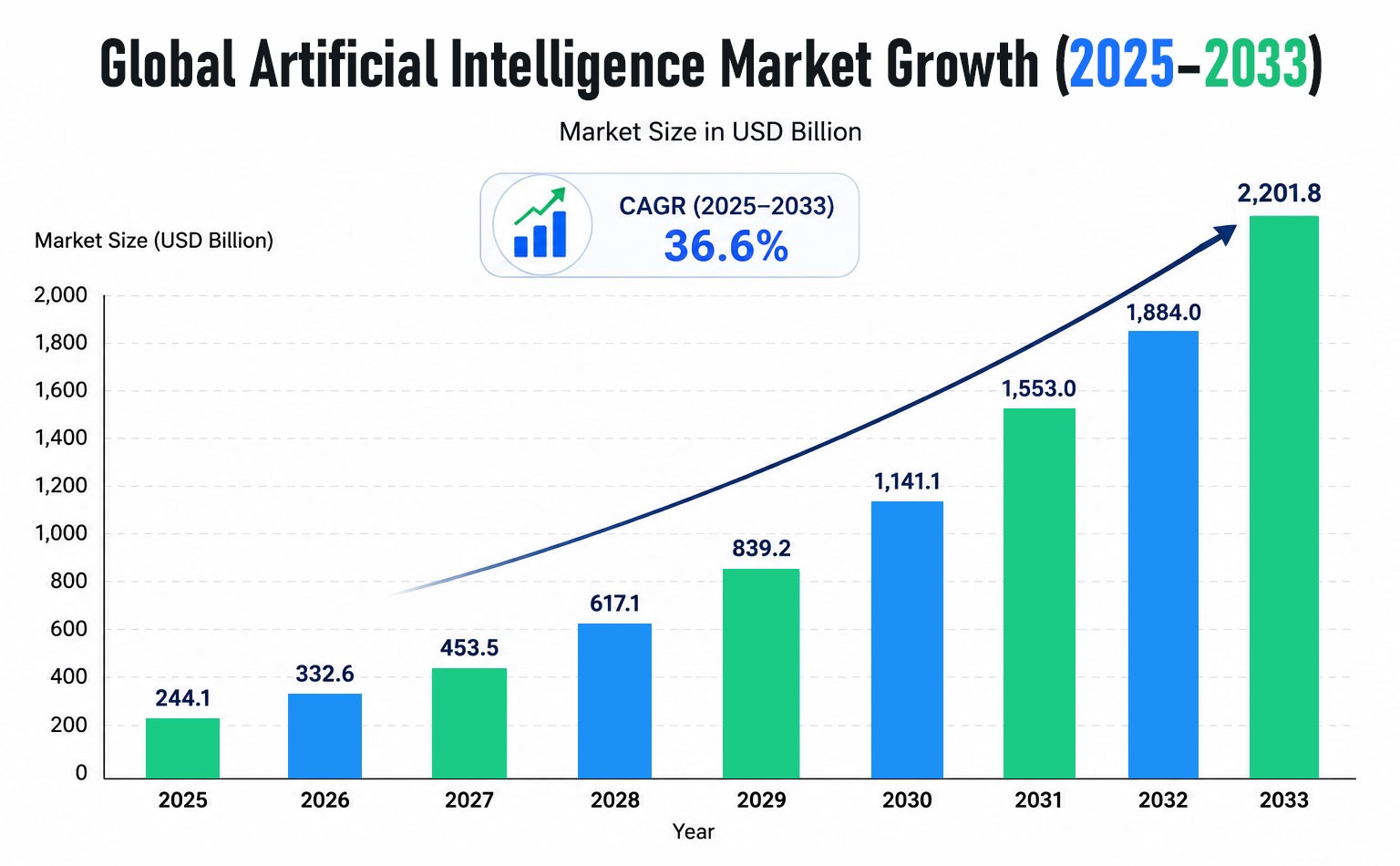
Experts predict that the global AI market will expand greatly, growing from about $390.9 billion in 2025 to around $3.5 trillion by 2033. This growth is mainly due to more people and businesses using smart tools that help with everyday tasks, automate processes, and improve decision-making across different industries.
Generative AI Statistics
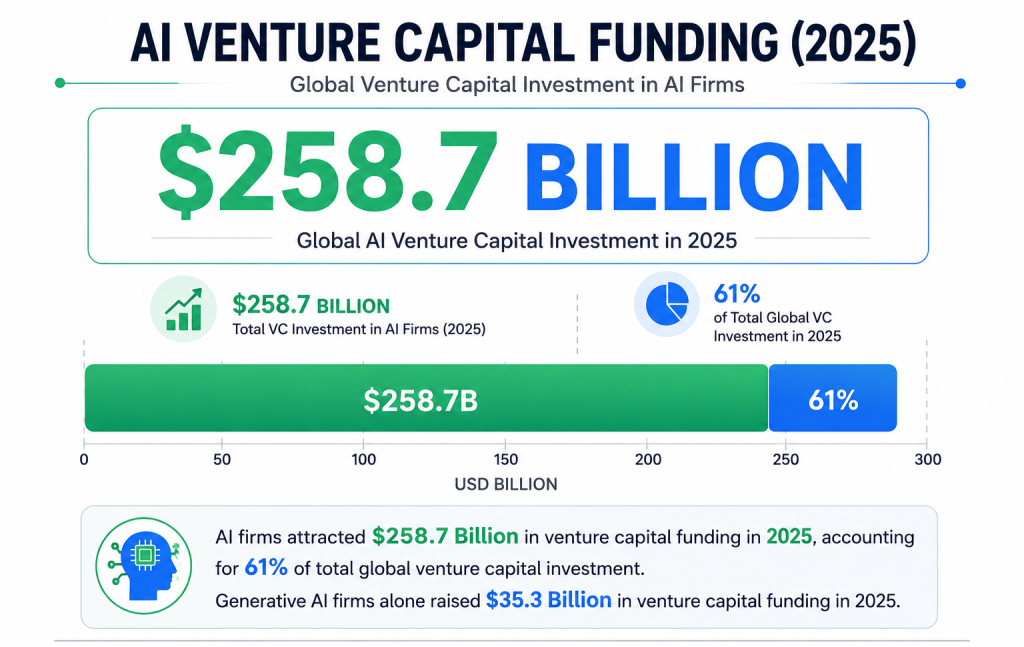
Key Generative AI & Enterprise Adoption Report trends worldwide.
- A $211 billion (updated to $212 billion in June 2026 data) venture capital funding for the entire AI sector in 2025, however, not exclusively for Generative AI startups. (Gencodex)
- Generative AI has reached 53% population-level adoption globally. (Stanford AI Index)
- 88% of enterprise organizations report utilizing AI in some capacity. (Stanford AI Index)
- Enterprise spending on AI models and APIs is forecast to reach $32.6 billion in 2026, a 110% year-over-year growth. (Gartner)
Workforce and Employment Statistics
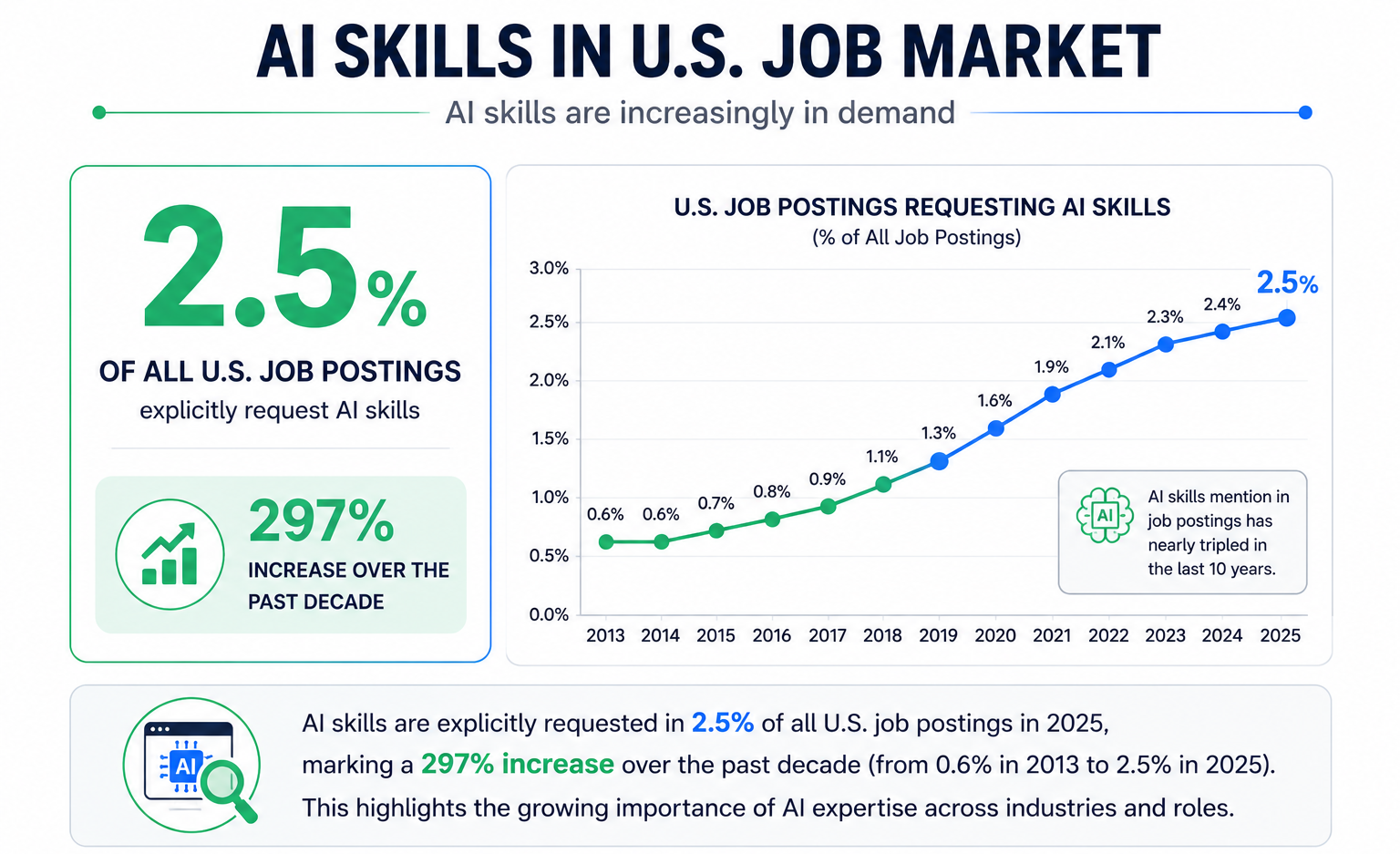
Key workforce, hiring, and productivity trends driven by AI adoption.
- AI skills are explicitly requested in 2.5% of all U.S. job postings, a 297% increase over the past decade. (Stanford AI Index)
- Employer demand for “Agentic AI” skills increased by 280% in a single year, creating roughly 90,000 new job postings in the U.S. (Stanford HAI)
- A joint MIT/Stanford study found a 14% average productivity increase for support agents, while a separate MIT study with Boston Consulting Group found up to a 40% performance quality improvement for consultants on specific tasks. (Gencodex)
- Recent AI reports do not state that 38% of companies hired AI-specialized talent. The “38%” figure of generative AI data refers instead to the percentage of organizations identifying resourcing constraints as a barrier, or the percentage expecting more than 20% of their workforce to be reskilled. (Gencodex)
- AI survey actually found that 8% of respondents expect the overall size of their workforce to decrease by more than 20% specifically due to AI adoption, which is much more severe than just 8% planning any layoffs. (Gencodex)
Read Also: 11 Best AI Coding Tools in 2026: Complete Comparison for Developers
Marketing, Retail, and E-commerce Statistics
Selected business adoption and cost optimization statistics related to AI implementation.
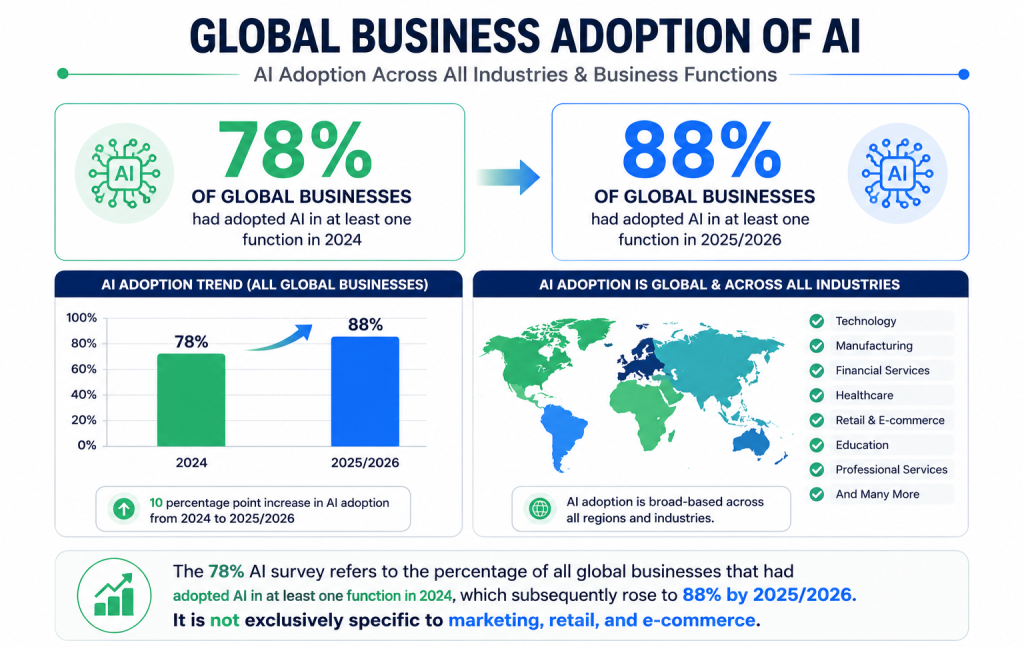
- The 78% AI survey refers to the percentage of all global businesses that had adopted AI in at least one function in 2024 (which subsequently rose to 88% by 2025/2026). It is not exclusively specific to marketing, retail, and e-commerce. (Gencodex)
- The AI data i.e. 56% is the percentage of AI-adopting businesses specifically in software engineering and manufacturing that report cost decreases. It does not represent a global average across all companies, nor is it largely attributed to customer support deflection. (Gencodex)
Finance and Banking Statistics
- 2025/2026 data shows overall enterprise adoption across all sectors at 88%, and does not cite a 40% ceiling specifically for finance. (Gencodex)
Operations, Manufacturing, and Supply Chain Statistics
Business impact metrics commonly associated with AI adoption across operational functions.
- 45% of operations and supply chain businesses have adopted AI however the 45% figure from McKinsey refers to the weighted average pass-through rate for new tariff costs in supply chains, not AI adoption. (Gencodex)
- 63% of companies report revenue increases typically apply to marketing and sales functions, not operational efficiencies. (Gencodex)
Legal and Compliance Statistics
- Reports are that Gen AI reduced costs in legal and compliance departments by 33%, rather than a 35% adoption rate. (Gencodex)
IT, Cybersecurity, and Infrastructure Statistics
Key investment, performance, and enterprise AI infrastructure metrics.
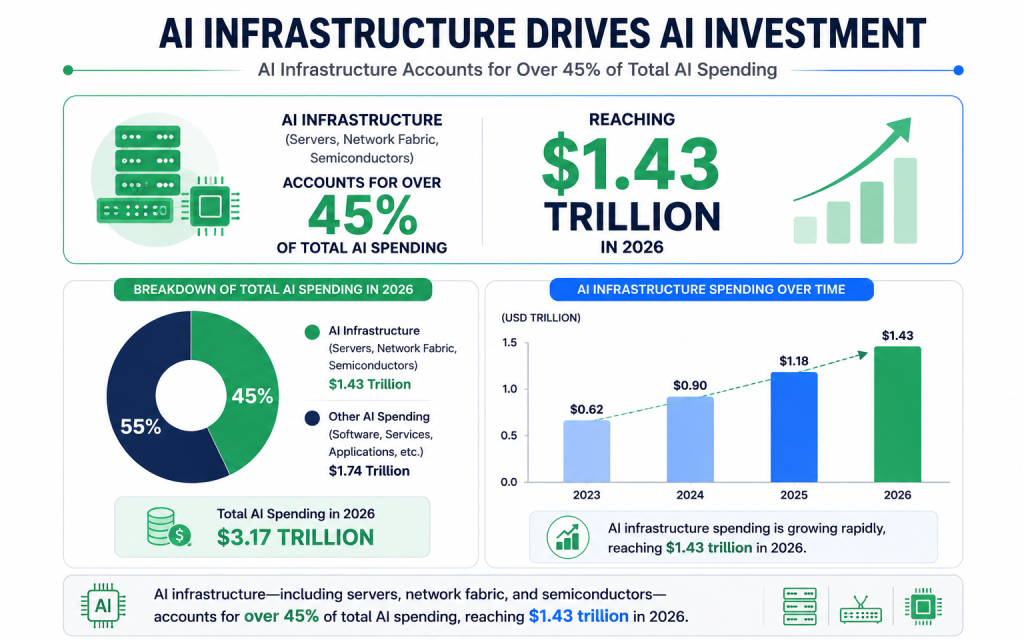
- AI infrastructure (servers, network fabric, semiconductors) accounts for over 45% of total AI spending, reaching $1.43 trillion in 2026. (Gartner)
- Spending on AI in cybersecurity is surging to $51.3 billion in 2026. (Gartner)
- AI agent accuracy in autonomous cyber defense tasks jumped from 15% to 93% accuracy in a single year. (Stanford AI Index)
- Gartner forecasts rapid agentic AI growth, but this specific 40% penetration stat for applications by 2026 is unverified. (Gencodex)
- 40% of early enterprise agentic AI projects will be canceled by the end of 2027 due to escalating API costs and unclear business value. (Gartner)
- The 2026 Stanford AI Index reports that agents handling real-world tasks jumped to 77.3% on Terminal-Bench. (Gencodex)
- 2026 enterprise benchmarks (like Vectara) show frontier model hallucination rates ranging much lower, between 3.3% and 14%. (Gencodex)
AI Energy and Environment Statistics
Key environmental metrics highlighting the growing energy and resource demands of AI systems.
- Global data centers consumed roughly 448 Terawatt-hours (TWh) of electricity in 2025. (UNU-INWEH)
- By 2030, AI data centers will require 9.3 trillion liters of water annually for cooling. (UNU-INWEH)
- 80% to 90% of AI energy consumption comes from inference (daily use of models) rather than initial model training. (Financial Express)
- Generating a single AI image consumes 1,450 times more energy than a basic text classification task. (Financial Express)
Leading AI Platforms Statistics
User adoption and business growth metrics across major AI platforms.
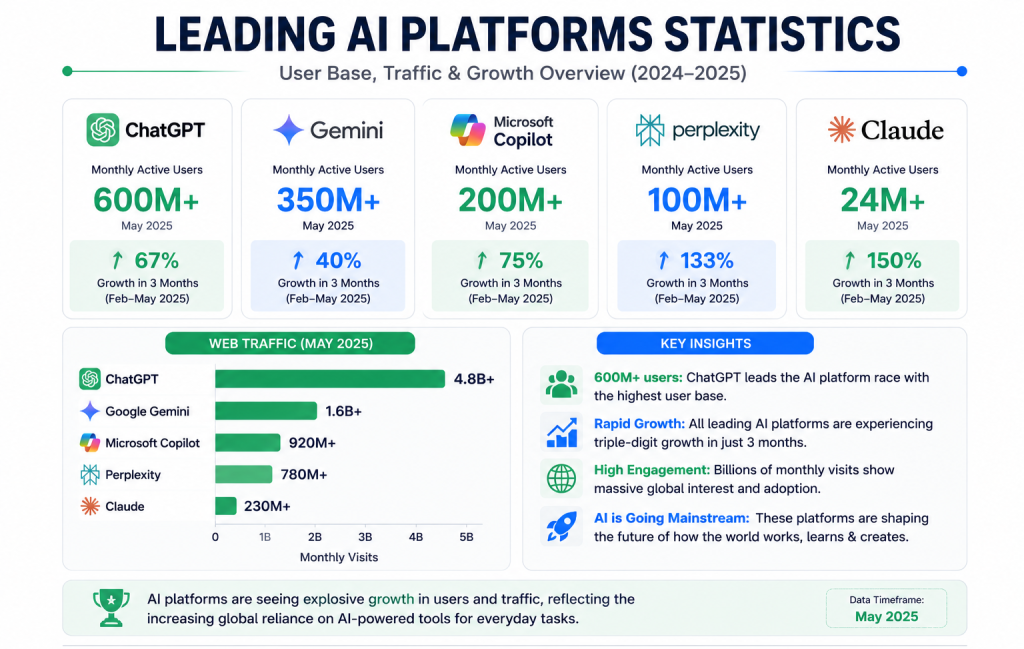
- ChatGPT dominates the global AI chatbot market with a 79.08% market share as of May 2026. (Statcounter)
- Perplexity holds the second-largest market share globally at 7.67%. (Statcounter)
- Google Gemini accounts for 7.03% of the global AI chatbot market share. (Statcounter)
- Microsoft Copilot captures 3.23% of the global AI chatbot market. (Statcounter)
- Claude holds a 2.98% market share worldwide. (Statcounter)
- ChatGPT reached 900 million weekly active users as of February 2026. (OpenAI / DemandSage)
- ChatGPT crossed the 1 billion monthly active users milestone in June 2026. (Sensor Tower / Reuters)
- ChatGPT receives approximately 5.51 billion monthly website visits. (Similarweb / DemandSage)
- Google Gemini reached 750 million monthly active users on its standalone app as of Q4 2025. (Google Earnings)
- OpenAI reached $10 billion in annual recurring revenue (ARR) in 2025. (Business of Apps / DemandSage)
- Over 50 million people globally subscribe to ChatGPT Plus and other premium OpenAI offerings. (Business of Apps)
- 120,000+ enterprise organizations currently use Google Gemini, including 95% of the top 20 global SaaS companies. (Google Earnings)
- 83.27% of users prefer ChatGPT as their primary AI tool for personal tasks however unverified. (Gencodex)
- Over half of all Google Gemini users are under the age of 35, with the 25–34 demographic making up the largest segment at 29.66%. (Similarweb / fatjoe)
- 73% of overall ChatGPT usage is non-work-related, marking a 20% increase from the previous year however, unverified. (Gencodex)
Conclusion
The data from 2026 speaks for itself: AI is no longer a novelty or a hype cycle. It has become a multi-trillion-dollar infrastructure that is driving measurable productivity gains, redefining job markets, and commanding massive amounts of global energy.
Whether you are an enterprise leader scaling operations or a professional adapting to new tools, understanding where these numbers are pointing is critical to staying ahead.
Did we miss any important AI statistics? Let us know.